

Patient flow management is one of those operational disciplines that feels straightforward in a small practice and becomes increasingly complex as the practice grows. A single clinician in a single room has a flow problem that is obvious and self-correcting. A practice with eight clinicians, twelve rooms, and three sites has a flow problem that requires deliberate management.
This article covers what patient flow management involves, where it breaks down in growing practices, and how a patient flow management system addresses the root causes rather than the symptoms.
What Is Patient Flow Management?
Patient flow management refers to the processes and systems that move patients efficiently through their care journey, from arrival to appointment to discharge or follow-up. In a clinical setting, this means managing waiting times, room allocation, clinician schedules, queue management, and the handoffs between each stage.
The distinction worth making early is between a full diary and effective patient flow. A full diary with poor patient flow management produces long waits, frustrated patients, and a clinical team that spends part of its day managing the consequences of scheduling errors. Patient flow management is about the quality of movement through the system, not just the volume of appointments on the books.
Why Patient Flow Breaks Down in Growing Practices
A practice with one clinician and one room has limited scope for flow problems. The clinician runs late, patients wait, and the cause is obvious to everyone involved.
The same practice with five clinicians, eight rooms, and two sites operates in fundamentally different conditions. One clinician running twenty minutes late affects every subsequent patient in that room, but the knock-on effect on adjacent rooms and clinicians is invisible without a connected patient flow management system. A room that becomes available is not automatically flagged to a clinician whose previous room is still occupied. Patients arriving for different clinicians join a shared waiting area with no visible indication of how long they have been waiting or who they are waiting for.
Add a second site and the picture becomes more complex still. Capacity at site one is invisible to site two. The practice has no aggregate view of where patients are waiting or which clinicians have capacity to see them.
These are the conditions in which a patient flow management system moves from useful to necessary.
The Most Common Patient Flow Bottlenecks
- Booking without room allocation. When appointments are booked without simultaneously confirming room availability, the diary fills in a way that cannot be delivered. Two clinicians are scheduled into the same room at overlapping times. The conflict surfaces on the day, at the point when it can no longer be easily resolved.
- Manual check-in at reception. A paper-based or verbal check-in process creates a queue at the front desk during peak arrival windows. Patients wait at reception before they wait in the waiting area. The clinical team has no real-time visibility of who has arrived until a member of reception staff tells them directly.
- No waiting room visibility. Without a patient flow management system showing current queue status, clinicians and administrators have to ask by phone or check in person. In busy periods, this communication breaks down and patients wait longer than the delay itself requires.
- Clinician delays with no downstream alert. A clinician who runs late has no mechanism to automatically inform the next patient or adjust the diary in real time. The information stays in the consultation room and the queue lengthens without the practice being able to respond to it.
- No cross-site capacity view. Each site’s patient flow is invisible to the others. Capacity cannot be redistributed across locations. A clinician with availability at one site cannot easily be offered to a patient whose wait is extending at another.
How a Patient Flow Management System Addresses These Bottlenecks
A connected patient flow management system resolves each of these bottlenecks at the point where they originate rather than after the fact.
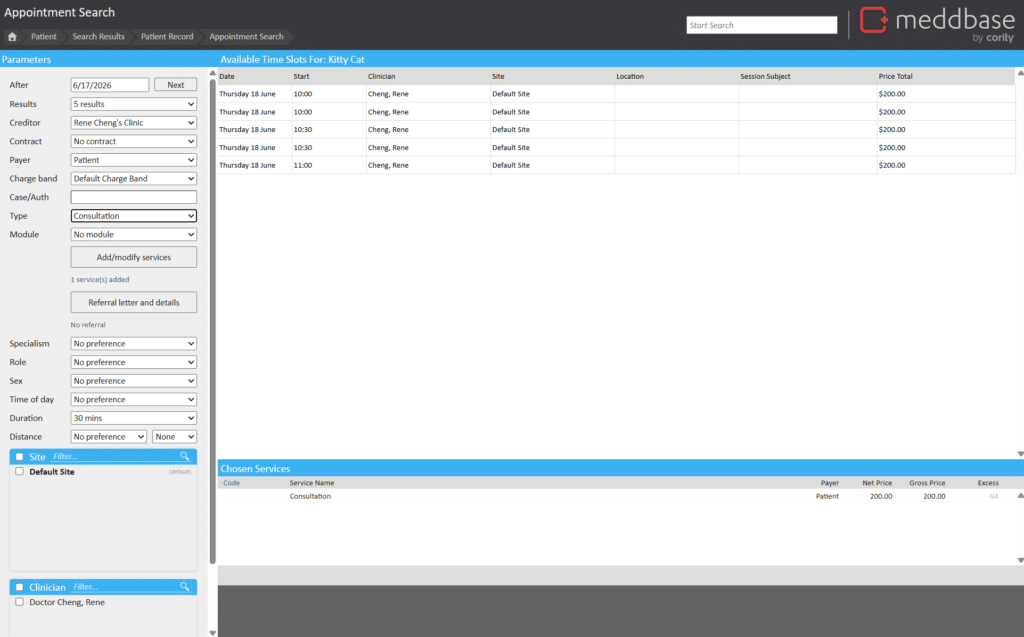
- Room allocation at booking. A patient flow management system that ties room availability to diary booking prevents double-booking at the source. When a clinician is scheduled, the system confirms room availability simultaneously and holds both.
- Digital check-in. Patients check in through a patient portal or a self-service kiosk rather than at the reception desk. Arrival is logged automatically in the patient flow management system and the relevant clinician is notified without a manual step. Waiting room load at peak times falls, and the queue becomes visible to the clinical team in real time.
- Live waiting room view. Clinicians and administrators can see who is waiting, how long they have been waiting, and which appointments are overrunning. Patient queue management software gives everyone in the practice the same real-time picture without requiring phone calls or physical checks.
- Delay alerts. When an appointment overruns beyond a defined threshold, the patient queue management system triggers a notification to reception, who can inform the waiting patient. The delay is still there. What changes is that it is visible and can be managed rather than discovered late.
- Cross-site capacity view. A patient flow management system with multi-site capability shows load across all locations in a single view. Practice managers can see where capacity is being underused and where patients are waiting longest, and make decisions across the network rather than within a single location.
What to Look for in Patient Flow Management Software
The single most important characteristic of patient flow management software is integration. Patient flow management software that operates separately from the booking system, clinical records, and billing platform requires manual updates to stay current. Updates happen late, the queue view becomes inaccurate, and the system stops being useful under the conditions where it is needed most.
Effective patient flow management systems draw live data from every part of the practice management platform. Diary changes update the flow view automatically. Check-in status feeds from the digital check-in tool without manual entry. Clinician schedules reflect real-time availability. Patient queue management works because the data behind it is live.
For practices evaluating patient flow management software, the questions worth asking are: does this connect to our diary system, our check-in process, and our clinical records? Does it show me cross-site capacity in one view? And what happens to the queue view when a clinician runs late?
Meddbase by Cority includes patient flow management as part of its connected practice management platform, with real-time diary views, digital check-in, waiting room visibility, and cross-site capacity management operating from the same data.